
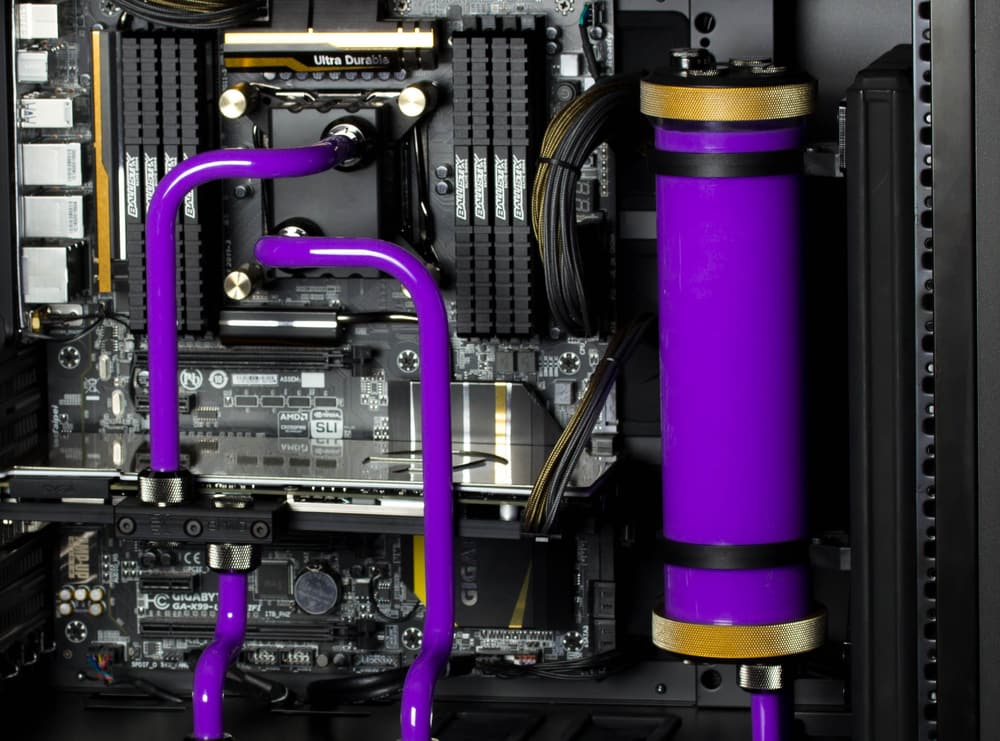
Bleeding Air From a New Loop
Updated August 17, 2026Air trapped in a freshly filled loop causes noise, poor cooling and pump wear. Tilt the case through several orientations while the pump runs, top up the reservoir as air clears, and expect the process to take a few sessions over a day or two.
A newly filled loop always contains air. Getting it out matters for more than noise: air pockets sitting in a block or radiator reduce heat transfer where you most need it, and a pump that swallows air runs louder and wears faster.
How to bleed a loop:
- Fill the reservoir as full as you reasonably can. The reservoir is the only place air should end up, and a fuller reservoir gives the pump a bigger buffer against running dry.
- Run the pump on its own, without powering the rest of the system. Most builders do this by bridging the power supply so the pump runs while the motherboard stays off, which avoids running components while the loop is still full of air.
- Run the pump in short bursts rather than continuously at first, topping up the reservoir each time the level drops as air is displaced.
- With the pump running, gently tilt and rock the case through several orientations — front to back, side to side, and upside down if you can do so safely. Air trapped at the top of a radiator or in a block will not move on its own; changing the orientation is what releases it.
- Keep topping up the reservoir. As air clears from the loop, the coolant level will fall.
- Repeat over a day or two. Air continues to work its way out of blocks and radiators for some time after the loop appears clear.
What to expect: Gurgling during the first hours is normal. Persistent gurgling after a couple of days of bleeding usually means air is still trapped somewhere the coolant cannot easily flush it, most often the top of a radiator or a horizontal run of tubing with a high point in the middle.
Pump speed while bleeding: Higher pump speed helps push air out of the loop and into the reservoir. Once the loop is clear, most systems run better at moderate pump speeds — high speed offers little cooling benefit and adds noise and vibration.
A note for show coolants: If you are running an opaque or pigmented coolant, bleeding thoroughly matters more than usual. Air at the coolant surface accelerates pigment breakdown, so time spent clearing air pays back in colour life.